
Most folks stepping off a flight into the Caribbean immediately notice the bright colors snapping in the ocean breeze. You see the Dominican Republic flag everywhere. It flies over resorts, hangs from local shops, and whips off the back of luxury yachts. But what you probably don’t realize while grabbing your luggage is that this specific piece of fabric holds a wild, unmatched world record. It is the absolute only national flag on earth featuring an open Bible.
Understanding the symbols stitched into this flag completely changes the way you look at the island. This isn’t just a generic tropical banner. It is a loud, proud statement of hard-fought independence and intense faith. Whether you’re heading offshore on an Isla Saona catamaran charter or wandering the busy streets of a local coastal town, knowing the history behind those colors adds serious cultural depth to your vacation. We are going to break down exactly what the colors mean, the underground secret society that created it, the strict maritime laws for boat tours, and the etiquette every respectful tourist needs to know.
Key Takeaways for Punta Cana Travelers
- A Global Outlier: The Dominican flag is the only national flag in the world that features a Bible in its design.
- Deep Color Symbolism: The blue stands for liberty under the sky, the red honors the blood of the nation’s founders, and the white cross represents peace and salvation.
- A Powerful Motto: The coat of arms boldly states “Dios, Patria, Libertad” which translates directly to God, Homeland, Liberty.
- Maritime Requirements: Every single registered commercial tourist boat is legally required to fly the flag proudly at the stern.
- Strict Respect Rules: Tourists should never let a souvenir flag touch the ground, nor should they ever use it casually as a beach towel or clothing wrap.
Quick Facts: The Dominican Republic Flag at a Glance
If you love hunting down amazing Punta Cana facts before a trip, the raw specifications of the flag are a great place to start. The government doesn’t take these details lightly. The design is protected by strict constitutional laws.
| Feature | Detail |
| Adoption Date | November 6, 1844 |
| Proportions | 2:3 or 1:2 (Width to Length) |
| Official Colors | Ultramarine Blue, Vermillion Red, White |
| Unique Feature | An open Bible placed dead center in the Coat of Arms |
| Original Designers | Juan Pablo Duarte, Concepción Bona, María Trinidad Sánchez |
The Deep Meaning Behind the Colors and Design
Nobody just picked these colors out of a catalog because they looked good together. Every single shape and shade on the Dominican flag carries intense historical weight. The founders of the nation engineered the layout to communicate a very specific message to the rest of the world about who they were and what they had sacrificed.
Ultramarine Blue – The Sky and Liberty
Let’s get one thing straight about the blue rectangles sitting in the top-left and bottom-right corners. This is a very specific ultramarine shade. It physically represents the sprawling Caribbean sky hanging over the island, but the true meaning goes much deeper. The blue symbolizes the endless, unyielding liberty that the Dominican people fought tooth and nail to achieve. It serves as a daily visual reminder to the citizens that God protects the nation from above, maintaining their freedom against any outside forces trying to take it away.
Vermillion Red – The Blood of the Heroes
The vermillion red sections on the top-right and bottom-left are heavy with meaning. They serve as a very solemn, direct tribute to the ultimate sacrifice made by the nation’s founders. This red explicitly represents the blood spilled by the heroes, soldiers, and everyday patriots who died fighting for independence. It isn’t meant to be aggressive. Instead, the red is a deeply respectful historical marker. It forces current generations to remember exactly how high the cost of their everyday freedom actually was.
The White Cross – Salvation and Faith
Slicing right through the middle and dividing the blue and red rectangles is a massive, striking white cross. You can’t miss it. This central cross stands for salvation, peace, and the incredibly deep Catholic heritage that defines the nation. The white color signifies the purity of the country’s ideals. Structurally, it physically binds the red and blue sections together on the fabric. This illustrates a beautiful concept: faith and peace are the ultimate glue that unites the bloody sacrifices of the past with the bright liberty of the future.
What Makes the Dominican Flag Unique in the World?
If you line up all the flags of the world, the Dominican banner stands completely apart. It holds a distinct world record that strictly reflects the country’s profound religious foundations. You won’t find this exact design philosophy anywhere else on the planet.
The Only National Flag with an Open Bible
Out of all 190-plus sovereign states globally, the Dominican Republic is the absolute only nation bold enough to feature a Bible right on its flag. Positioned directly in the center of the cross, tucked neatly inside the coat of arms, the Bible rests wide open. This emphasizes a core cultural belief. Faith isn’t just a background element for the locals. It is the central, guiding pillar of the country’s entire legal and moral framework.
The Significance of the Verse John 8:32
They didn’t just slap a closed book on the flag and call it a day. The Bible is intentionally drawn open to a very specific page. It is turned to the Gospel of John, chapter 8, verse 32. If you look closely at a high-quality flag, the tiny text reads: “Y la verdad os hará libres.” In English, that translates to “And the truth shall set you free.” The founders chose this specific scripture because it perfectly aligned with their bloody pursuit of independence. It reinforces the idea that true, lasting liberty is always rooted in spiritual and moral truth.
How It Differs from the Haitian Flag
Because the island of Hispaniola is shared by two completely distinct nations, their histories crashed into each other constantly. During the brutal Haitian occupation of the Dominican side (which lasted from 1822 to 1844), the Haitian flag—featuring simple blue and red horizontal bands—was forced upon the territory. When the Dominican secret society, La Trinitaria, started plotting their rebellion, they intentionally used the existing Haitian flag colors but aggressively superimposed a large white cross right over it. This bold addition explicitly differentiated their new nation. It broke up the horizontal blocks of color and put their Catholic faith front and center.
Deconstructing the Dominican Coat of Arms
You can’t really say you understand the flag without zooming in on the detailed crest sitting dead center. The coat of arms acts as the official national seal. It features several distinct elements that tell the gritty story of the country’s resilience.
The Shield, Spears, and Laurel Branches
Look closely at the central shield. It is flanked by two prominent branches that look a bit different from each other. On the left side, you’ll see a laurel branch, which is a classic historical symbol for immortality and victory in battle. On the right side sits a palm frond. This represents liberty while also giving a nod to the tropical nature of the island itself. Behind the shield, you will notice three solid spears on each side, two of which are actually holding up smaller Dominican flags. These spears aren’t just decorative. They denote the absolute readiness of the Dominican people to pick up arms and defend their hard-earned sovereignty at a moment’s notice.
The National Motto: Dios, Patria, Libertad
Directly above the main shield, there is a bright blue ribbon displaying the national motto in sharp, bold letters: Dios, Patria, Libertad. This translates to God, Homeland, Liberty. Notice the strict hierarchy there. It shows that faith comes first, dedication to the country comes second, and the pursuit of individual freedom naturally follows. It’s a phrase you will hear constantly when digging into the languages spoken in the Dominican Republic, as it represents the absolute core of Spanish Dominican patriotism.
A Brief History of the Flag and Its Creators
To actually appreciate the fabric flying over your resort pool, you need to look back at the minds and hands that physically created it. The story of this flag reads like a thriller. It involves secret underground societies, brave visionaries, and incredibly courageous women. If you are traveling from Santo Domingo to Punta Cana, you are literally driving the very same routes where these historical figures plotted their revolution.
Juan Pablo Duarte’s Vision
Juan Pablo Duarte is universally recognized by locals as the central founding father of the Dominican Republic. He was the chief architect of La Trinitaria, a highly secretive underground movement completely dedicated to achieving independence from Haiti. Duarte personally conceptualized the initial design of the flag. He was the one who firmly decided that the massive white cross was necessary to symbolize the divine protection he believed the fragile new nation would desperately require.
Concepción Bona & María Trinidad Sánchez
While Duarte had the big-picture vision, two remarkable women actually brought it into the physical world. Concepción Bona and María Trinidad Sánchez were heroic seamstresses. They didn’t just design the flag on paper; they physically sourced the fabric, cut the complex patterns, and stitched the very first Dominican flag by hand. And they did this under intense threat. They operated at great personal risk, hiding their brightly colored materials from the ruling authorities. Eventually, they hoisted their handmade creation on February 27, 1844, at the Puerta del Conde in the capital, officially marking the birth of the nation. If you want to walk exactly where they stood, visiting the colonial zone is easily one of the best things to do in Santo Domingo.
Historical Timeline (1492 to Independence in 1844)
Understanding why the flag was necessary requires knowing the chaotic timeline of the territory itself. According to verified historical data from the CIA World Factbook, the journey to sovereignty was a bumpy, bloody ride.
- 1492: Christopher Columbus lands on the island of Hispaniola, kicking off centuries of Spanish colonial rule.
- 1795: Spain shockingly cedes the eastern two-thirds of the island over to France.
- 1809: The territory is violently returned to Spanish control.
- 1821: The locals achieve a very brief independence, known historically as the Ephemeral Independence.
- 1822: The neighboring nation of Haiti invades and unifies the entire island under one iron-fisted rule.
- 1838: Juan Pablo Duarte establishes the secret society La Trinitaria in the shadows.
- 1844: Complete independence is finally declared on February 27, and the first official flag is raised into the sky.
Historical Flags of the Dominican Republic
The modern flag you see today didn’t just materialize out of thin air. It evolved through several drastically different iterations as control of the island shifted constantly between different global superpowers over the centuries.
The Cross of Burgundy (1492-1821)
During the extensive, brutal era of Spanish colonization, the official flag flown over the territory was the Cross of Burgundy. This banner was intimidating. It featured a jagged red saltire (an X-shaped cross that looked like two crossed, rough-cut branches) sitting on a stark solid white background. It represented the Spanish Empire’s absolute military and naval dominance in the New World.
The Flag During Haitian Occupation (1822-1844)
When Haiti rolled in and controlled the entire island of Hispaniola, the official flag was forcibly changed to a simple horizontal bicolor of blue over red. This twenty-two-year period heavily influenced the Dominican founders. They realized that to establish a completely new identity that locals could rally behind, they needed to fundamentally alter the visual representation of the state while acknowledging the existing colors the public was used to seeing.
The Early Flag of La Trinitaria
The earliest prototype versions used by La Trinitaria in their secret meetings closely mirrored the Haitian flag but featured that defining white cross superimposed directly over the center. In later revisions, the blue and red blocks were physically alternated to create the specific checkered quadrant layout we recognize today. This brilliant design tweak visually balanced the intense concepts of liberty and sacrifice perfectly.
The Dominican Flag at Sea: Maritime Rules & Boat Tours
For travelers looking to explore the stunning coastline, maritime flag etiquette is a very serious matter. Whether you book luxury private boat tours in Punta Cana or just rent a wild jet ski Punta Cana for the afternoon, you will notice a surprisingly strict adherence to naval flag protocols out on the water.
Flying the Flag on Catamarans and Yachts in Punta Cana
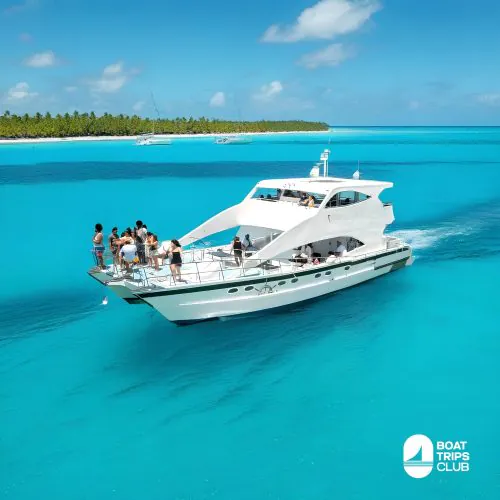
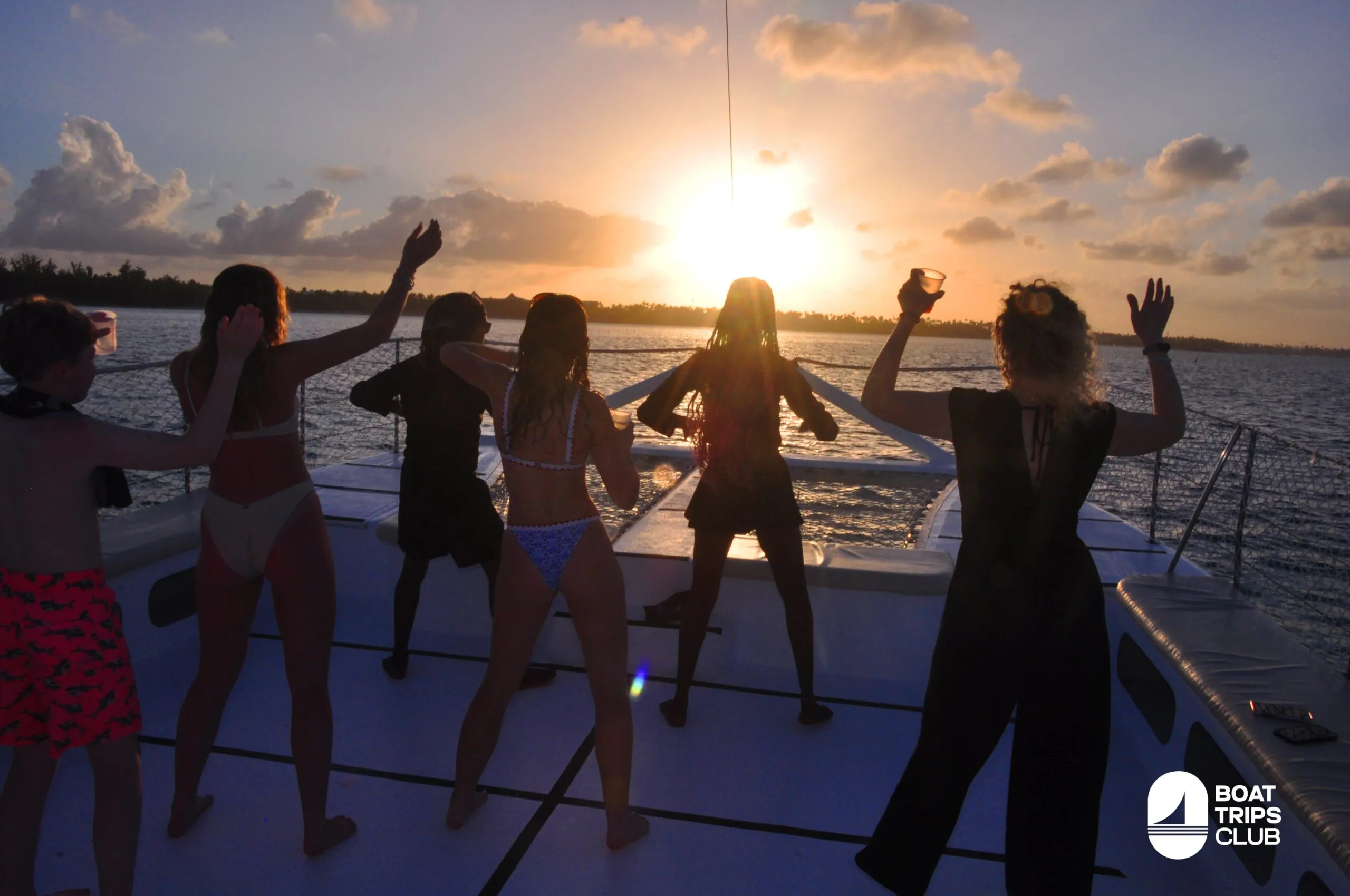
According to local Dominican maritime law, all registered commercial tourist vessels must proudly display the national flag at all times. When you board a private catamaran adventure in Bavaro, you will consistently see the flag flying off the stern (the back) of the boat. And it isn’t just an afterthought. The flag must be kept in absolutely pristine condition. The heavy ocean winds and aggressive salt spray destroy fabric fast, so faded, torn, or frayed flags are immediately replaced by boat captains. As you head out on a serene sunset cruise, the sight of that massive flag snapping loudly in the evening breeze makes for a phenomenal, highly authentic photograph.
The Dominican Navy and Coast Guard Flags vs. Civil Flag
It is definitely worth noting that while civilian boats and everyday tourist charters fly the standard national flag, official military vessels use a slightly different ensign. The Dominican Navy and Coast Guard flags feature the exact same base design but are strictly regulated regarding their exact dimensions, and they often carry highly specific naval seals in the corners. Tourist charters legally stick to the civil ensign to show their national pride while operating offshore without impersonating the military.
Where to See and Photograph the Flag in Punta Cana
You really do not have to look hard to find the flag in the Dominican Republic. However, knowing the absolute best places to capture a great photo—and exactly how to do it respectfully—ensures you get the best experience without offending the locals.
Best Spots for Tourists
Your first real encounter with the flag will likely happen the exact second you step off the plane. While you are busy fumbling with your official e-ticket for the Dominican Republic and trying to organize your Punta Cana airport transfers, you will see massive flags flying right outside the terminals. You will also see them prominently displayed at local government buildings, heavily guarded police stations, and at the grand open-air entrances of almost all luxury resorts. To fully understand where Punta Cana is located geographically in relation to the capital, you will notice that flag density increases heavily as you drive closer to the major administrative hubs in the province of La Altagracia.
Respectful Photography Etiquette for Travelers
When framing up a shot of the flag for your Instagram or travel memories, you must treat the symbol with high regard. If you purchase a small flag from a vendor, never let it drag on the ground, and absolutely do not use it as a makeshift beach towel or a bikini wrap. The locals are incredibly, fiercely proud of their heritage. Treating their national symbol with deep respect is an easy way to ensure you have a positive interaction with locals. In fact, respecting the culture directly reinforces why is Punta Cana safe to visit is always answered with a resounding “yes” for respectful tourists. Always read through a comprehensive Punta Cana travel guide to familiarize yourself with basic local courtesies before you land.
Buying Dominican Flag Souvenirs: A Traveler’s Guide
Taking a piece of the Dominican Republic home with you is a fantastic idea, but you need to know exactly what you are purchasing to ensure you actually get an authentic item rather than a tourist-trap fake.
How to Spot Authentic vs. Cheap Knock-offs
When you finally go shopping in Punta Cana, you will find flags sold in literally every single market, roadside stand, and resort gift shop. However, many cheap, mass-produced knock-offs imported from overseas completely omit the central coat of arms or feature a heavily distorted, blurred version of the Bible and shield. An authentic flag must have the crisp, clear coat of arms dead center. When negotiating prices with a vendor, make sure you understand the local Punta Cana currency conversion. This ensures you are paying a fair, accurate rate for a high-quality, woven cotton fabric flag rather than cheap, printed plastic-feeling polyester.
Best Local Shops in Punta Cana for Cultural Gifts
Instead of just grabbing overpriced souvenirs at the airport terminal on your way out, head deeper into the local artisan markets in Bavaro or Downtown Punta Cana. Here, you can find incredible hand-stitched flags, locally crafted heavy wood carvings of the coat of arms, and thick glass bottles of traditional Mamajuana. Buying directly from these local vendors not only ensures you get a far more authentic product, but it also directly supports the local economy of the people hosting you.
Flag Etiquette: Display Rules and Important National Days
The Dominican government does not mess around when it comes to flag etiquette. They have clear, strict laws about exactly how the flag should be displayed, and these rules intensify heavily during national holidays.
Display Guidelines for Citizens and Tourists
By strict local law, the flag is raised at exactly 8:00 AM and must be officially lowered at 5:30 PM (or right at sunset). It is very rarely flown overnight unless it is heavily illuminated by bright spotlights on a government building. When displayed vertically against a wall, the blue quadrant must always be situated in the upper left corner from the observer’s perspective. If you are spending time learning about what Punta Cana means and digging into the local vibe, respecting these visual display rules shows the locals you actually care about their heritage.
Celebrating Dominican Independence Day (Feb 27) & Restoration Day (Aug 16)
If your trip happens to align with February 27 (Independence Day) or August 16 (Restoration Day), you are in for an absolutely massive cultural treat. According to the official Dominican Republic Ministry of Tourism, the entire country practically erupts in vibrant street parades, blasting live merengue music, and overwhelming, beautiful displays of the national flag. It is the absolute best time of the year to dive into heavy, traditional Dominican food like sancocho and mofongo. Attending these parades ranks highly among the absolute best things to do in the Dominican Republic during the winter travel months.
Frequently Asked Questions (FAQs)
Why is there a Bible on the Dominican Republic flag?
The open Bible heavily symbolizes the deep Catholic faith of the brave men and women who founded the nation. It is specifically positioned right in the center to show the world that the country’s laws, its moral compass, and its aggressive pursuit of liberty are strictly guided by divine truth.
What do the colors of the Dominican flag mean?
The deep ultramarine blue represents the massive Caribbean sky and the eternal liberty of the nation. Vermillion red stands for the actual blood shed by patriots during the violent fight for independence, and the striking white cross signifies salvation and peace.
Is the Dominican flag similar to Haiti’s flag?
Yes, the original Dominican revolutionaries used the Haitian flag (which features simple blue and red horizontal bands) as their physical base template. They specifically added a large white cross right over the top of it to differentiate their new nation, putting faith first and breaking up the colors.
What is the Dominican national motto?
The official national motto is “Dios, Patria, Libertad.” This translates directly to “God, Homeland, Liberty,” highlighting the country’s incredibly strict hierarchy of values that focuses on faith first, the nation second, and individual freedom third.
Can tourists fly the Dominican flag?
Yes, tourists are more than welcome to purchase and display the Dominican flag at their homes or during their trip. However, they must treat it with high respect at all times, ensuring it never drags on the ground and is never used as casual clothing or a sandy beach towel.
Do boat tours in Punta Cana fly the national flag?
Yes, maritime law strictly requires all registered commercial tourist vessels to fly the flag clearly at the stern. If you want to see those vibrant colors flying against the stunning Caribbean horizon, book a luxury catamaran or yacht tour with Boat Trips Punta Cana to experience the coastline the right way.